
Ethereum’s $1,800 Hurdle: The Defining Battle for Summer 2026

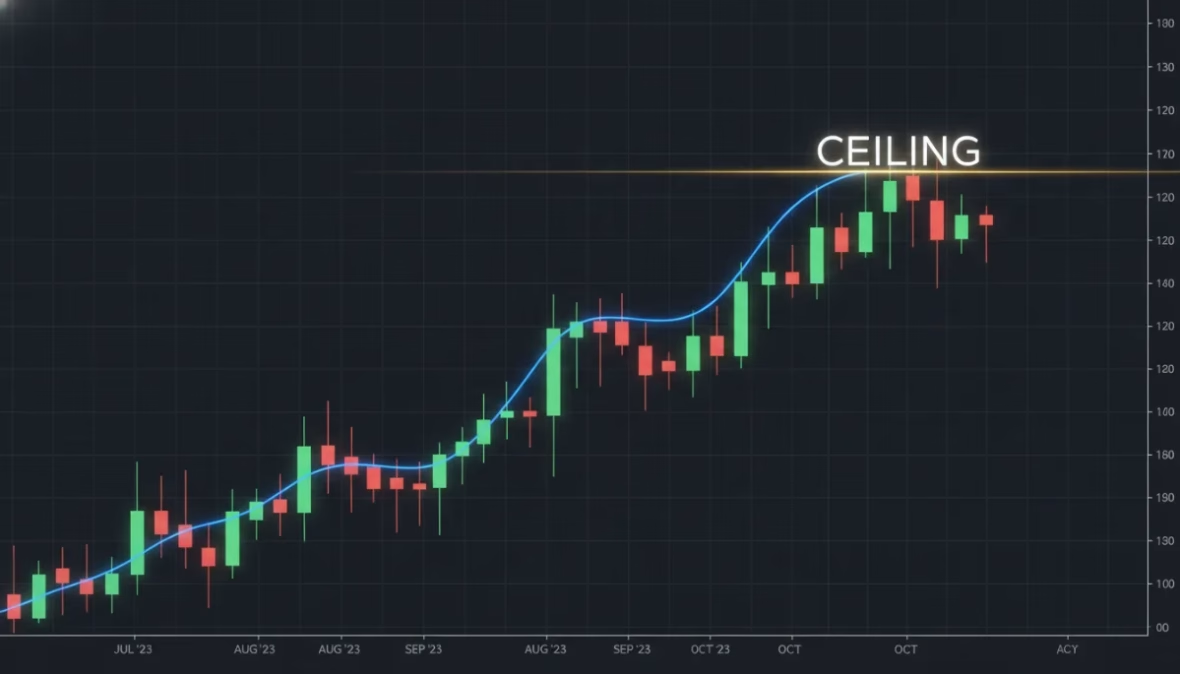
The $1,800 Price Point: A Critical Technical Fortress
Ethereum is currently locked in a high-stakes standoff at approximately $1,779, with the $1,800 level acting as a formidable barrier that defines the market’s trajectory for July 2026. This price point is not merely a psychological round number; it represents a structural convergence of the daily pivot, the 50-day Exponential Moving Average (EMA50), and a cluster of short-term resistance levels on hourly charts. For Ethereum to break out, it requires a decisive, volume-backed close above $1,800 to transform this ceiling into a new floor; until that happens, sellers are aggressively defending the line to exhaust buyer momentum.
Timeframe Dissonance: Daily Hope Versus Hourly Reality
The current market environment is complicated by a “timeframe dissonance” where long-term and short-term signals contradict each other. On the daily chart, indicators offer a glimmer of hope: ETH is holding above its 20-day EMA, and the daily MACD has signaled a bullish crossover, suggesting selling pressure is diminishing. However, the narrative flips completely on the 1-hour and 15-minute charts, where the market remains unambiguously bearish with the Relative Strength Index (RSI) leaning toward oversold territory. This disconnect creates a treacherous trading environment where buying into rallies without a breakout is akin to running into a headwind.
Macro Pressures: Bitcoin Dominance and Fear
Ethereum cannot be analyzed in isolation, as Bitcoin dominance is hovering around 56%, stifling independent momentum for altcoins. In this “risk-off” environment, capital flows toward the perceived safety of market leaders due to geopolitical tensions and macroeconomic uncertainty. The Fear & Greed Index remains locked in the “Fear” category at 28, driving participants to seek liquidity and exits rather than value in altcoins. Consequently, Bitcoin dictates the market tempo, leaving Ethereum to compete for redirected volume scraps.
On-Chain Signals: Repositioning Over Bullish Inflow
A surge in Decentralized Exchange (DEX) activity over the last 24 hours provides a critical on-chain signal that contradicts a simple bullish narrative. Uniswap V3 fees have jumped nearly 49%, and Curve DEX is experiencing a similar explosion in volume. Such a fee increase during a downturn typically signals active repositioning rather than a stampede of new buyers; investors are likely moving tokens to cold storage, rebalancing portfolios, or hedging against further downside. This suggests the market is twitchy, with participants bracing for volatility rather than leaning into a bull run.
Two Distinct Paths: Breakout or Structural Vacuum
The coming week presents two distinct realities for Ethereum, depending on how the $1,800 barrier is handled.
- The Bullish Breakout: A sustained hourly close above $1,800 would trigger a short-squeeze, forcing resistance bettors to buy back positions and creating a self-fulfilling pump. This could open the path to $1,825, with potential to test upper Bollinger bands near $1,884.
- The Bearish Slide: If the $1,800 wall holds and the $1,753 support level breaks, momentum evaporates into a “structural vacuum”. Below $1,753, historical buying interest drops significantly, risking a rapid price slip and a wave of technical selling.
Strategic Approach: Patience in a Volatile Regime
For traders and investors, the primary lesson is to not fight the range. Flipping coins while the price is pinned between $1,753 and $1,800 is a high-risk, low-reward game of chance that essentially bets against the dominant market forces. The optimal strategy is patience, waiting for a confirmed breakout or breakdown to validate the next move before committing capital.


